

THEME X
WORKSHOP PERSONNEL
The training school of Quatre-Mares
In communes such marked by the presence of the railroads as "Saint Etienne du Rouvray" and "Sotteville-lès-Rouen", one was often without wanting it Cheminot of wire father. Buddicom and especially Quatre-Mares were employment assured for the children outgoing Cheminots of the school of training or the technical school Marcel Sembat in "Sotteville-lès-Rouen".
If the apprentices who go out of the training school of QM are integrated directly in workshops, it is not the same thing for those stemming from technical schools not - S.N.C.F.. To be "hired", it was indeed necessary to take an examination, under the shape of a part to be executed (generally a dovetail for the mechanics). If the candidate was received, he received a training «on the heap " at the side of a former before merging within workshops. With the conversion in the diesel the recruitment will be made on title (C.A.P, C.F.P.A, etc.) without entrance examination, after a training course in school of Network to learn the ABC of the railroad technology.
Beyond the only hereditary aspect, other motivations could push the young people to enter at the workshops of QM; A certain job security related to the constancy of the railway activity, the retirement at 55 years and the free use of the train for the agent and its family (a quota of license of circulation was allotted for the year). At the time where the car had not become extensive that one knows to him today, the gratuitousness of the train was really an advantage of weight.
In addition the agent of QM and its family profited from the social services reserved for the whole of the agents from S.N.C.F., free medical hedging, summer camp for the children, residences, library etc… The agent and its family also had in Saint Etienne of Rouvray a stewardship located in the middle of the City of Familles like in Sotteville-the-Rouen close to the passanger station, where they could get food products and purposes of everyday consumption at reasonable prices. Moreover, one complete stage, located at Sotteville was at the disposal of Cheminots (the S.S.C.C. - Stage Sottevillais Railwayman Club).
The training school of Quatre-Mares
The need for training a qualified personnel and prepared with the very specific work of the repair of the engines with vapor, pushes the management to create a school of training in QM The establishment is thus supplemented by a school of training arranged in the most modern spirit. It opens its doors in 1932, a prelude to the closing of that of “Buddicom” in 1935, and initially finishes the instruction of about thirty apprentices of third year, who spent their the first two years of training to the practical school of industry Marcel Sembat of Sotteville-the-Rouen.
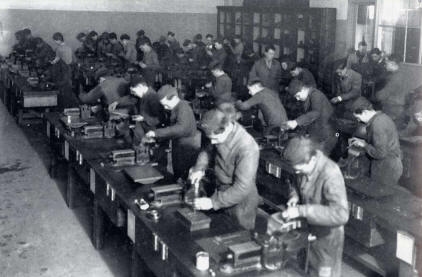
It is into 1935 that the totality of the training will be carried out at QM. This school understands a fitter's workshop and machine tools, against with a pit allowing the repair of a locomotive and a workshop for the wood and iron work for the repair of the cars travellers. A classroom, a refectory, a cloakroom and shower cubicles were installed for the apprentices. Lastly, a court with equipment of gymnastics and a covered courtyard. They lay out, moreover, with the workshops of “Buddicom”, of a circle where they can meet. The entrée at this school being done on contest open to the old teenagers from 14 to 16 years, the new “Arpètes” were to then follow three years of studies ensured by instructors of technical education like by instructors specific to the railroad.
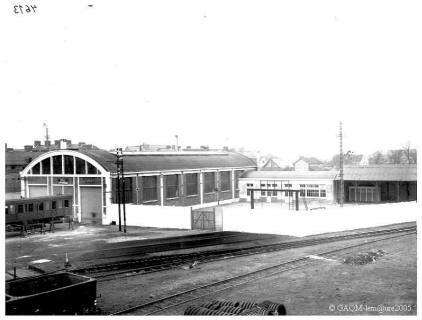
The school of training before 1939
The school of training was to train pupils with the trades of fitter, ironmonger, turner, metal worker, blacksmith, garnissor and later of electrician. In short as much of profession than the repair of an locomotive with vapor required. The first 6 months were devoted to the guideline of the pupils towards one or the other of these branches. This guideline took shape via varied tests (method CARARD) for flush out of the ironmonger or the electrician at the teenager. This distribution thus made, teaching itself could start. The first year, the pupils followed of the cours of general culture and from technology and they received the first concepts of their speciality. A small decreasing monthly remuneration is perceived by the pupil according to his classification and of its year (for example in 1943:100 francs for the 1st year, 200 for the second and 500 for the third year following the results obtained). The second year, technical education and practical was accentuated.
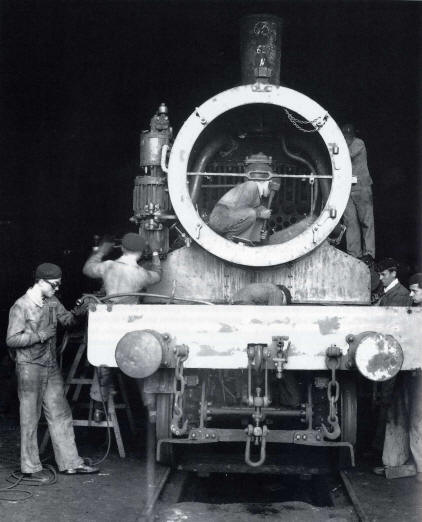
Apprentices of 3rd year
Finally the third year of teaching was supplemented by the complete repair of a standard locomotive 230 by the "Arpètes". Formed on the practical and theoretical level the pupils passed the examination of end of study. The received is integrated in the workshops of QM. The best of them also had the possibility of continuing their formation to integrate the maistrance- (In 1960,70% of the executives and supervisors of QM were resulting from the school of training). But in 1956, 80% of promotions 1945 to 1950, will be employed by the new company “Renault” installed in "Cléon".
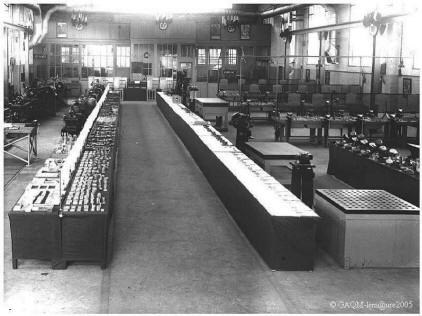
Thus during these three years of study the pupils acquired a knowledge of high-quality in their future branch but also the direction of team work thanks to the practice of collective sports such as football or the tennis shoe. On the same basis the discipline inside the training college was inculcated in a strict and rigorous way. Appeal “in row” in the schoolyard where with the exhortation of the instructor, the watchword of “Apprentis of the Ouest” those were to answer “Toujours rights” in an impeccable behavior. In the same way at the time of faults made by the pupil the sanction was marked before the assembly of the apprentices joined together for the occasion. But the hardness of this discipline forged the future railwaymen to face all the proofs of the life. The excellent reputation of the school, in spite of this strict discipline, imposed by the instructors, will attract a great number of pupils largely exceeding the borders of the agglomeration, which leads the management of QM to make build a boarding school.
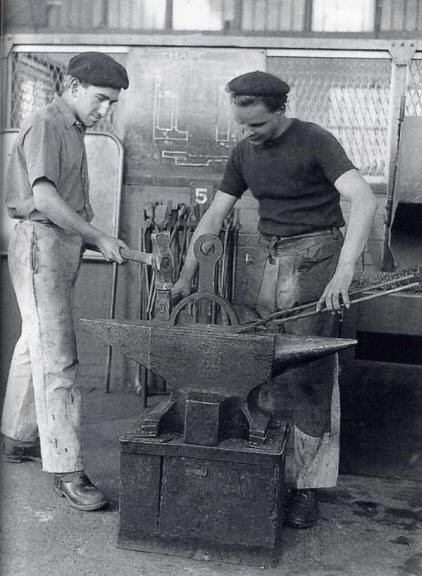
With the passing of years the contents of teaching will transform according to into that the technical development of the engine and the activity of QM Dieselist, electrician…. the blacksmith or the garnissor replaces. The school thus plays a big role at the time of conversion by providing a qualified personnel in the novel method of the diesel. However in the Eighties the existence of the school is called in question. The natural outlets of the school which the workshops of QM constituted are practically dried up.
.jpg)
In 1988 the decision to close the school is made because the level of recruitment does not justify any more the maintenance of his own school of training. The school thus closes after having seen passing on its benches several hundreds of pupils (between 1943 and 1959, an average from 100 to 150 pupils of 1st, 2nd and 3rd year followed the exchange rates of the school of training of QM). These pupils knew to give its noble letters to this school of training throughout its existence.
In 80 years of existence the repair shops of Quatre-Mares saw ravelling several thousands of workmen between their walls. That it is with the service of “Réseau de l’ État” or “S.N.C.F.” several generations are succeeded to ensure the repair of the diesel-electric locomotives and with vapour then without never failing in the task. However in 80 years, the work conditions evolved/moved much. Nothing is comparable, indeed, between the workman of the time of the vapour and that of the diesel, both it is in the field of the duration of day's work, the work conditions or the relationship with the hierarchy.
Before 1936, the working week was 46 hours distributed over 6 days. The job beginning the morning at 6:42 with the sound of the siren of the workshops of QM. The morning of work was finished at 11:30 to leave time to the employees to go to eat. Work started again then at 13:00 to finish at 17:00.
In 1936, the workweek is 40 hours, by the Act of June 21, 1936. However, the period of occupation and the German grip on Workshops QM causes an increase in working time by setting it to 10 hours a day.
But the release does not mean the return to normal. On the contrary. The influx of work related to the reconstruction of France obliges to maintain 60 hours of the week. The efforts are paying off. This helps to reduce the workweek to 54 hours in the early 50's.. Since then, the weekly decline steadily to the 39h. with the order of 17 January 1982 on the working hours.
For the majority of employees of QM, the day has always started at about 7h.00 am. But some teams have had staggered hours (4:00 / 12.00) including those responsible for the repair of locomotives rugged. One service 2 / 8 is even applied to the machine tool business in the fitting shop.
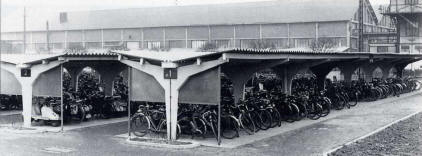
Bicycle storage
In the 60s the majority of the staff go at the workshops of QM on foot or to bike. Until this time many workers lived to St Etienne du Rouvray and to Sotteville Lès Rouen, in only inhabited cities by Railroad employees such as the "Cité des Families, or the " Cité des Castor".
For the agents living farther, a nicknamed train " the train of the senators ", and reserved for the railroad employees, were coming to deposit them in the establishment. ( The locomotive, then uncoupled of the train, serves as locomotive of laborer in the court of QM). The automobile car was another luxury. Rare were the railroad employees to possess one.
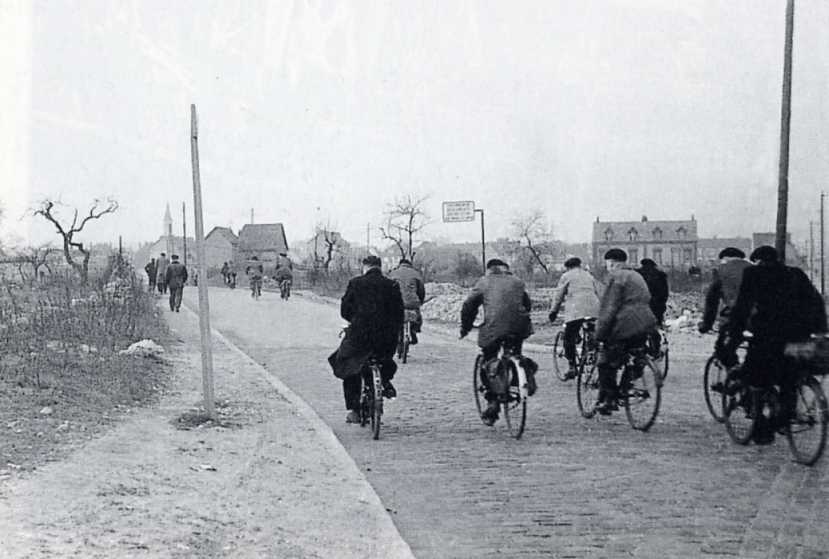
The return to home
The threshold of QM crossed over under the eye of guardian, which noted the name of the latecomers (at the end of three delays a written justification is asked to the person), the workers go to the changing rooms to get dressed their coveralls.
For those whose works were very dirty, these clothes were supplied and cleaned free of charge by the establishment. Some, to spare time, arrived directly in coveralls.
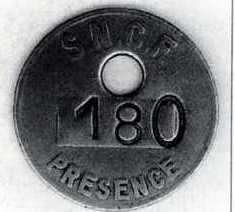
token of presence
The working dress consisted then of a pants and a jacket in cotton of color blue. For the staffs working on machine tools, clogs were supplied to protect the feet of shavings of sharp metal. The clogs will be present until 1960. Once in workwear, the workers were going to remove their attendance fee (disk of numbered bronze) from the board which was in the entrance of every workshops and it until 1972 dates in which one it is the team leader who will note the presences or the absences. Each win then the workstation, satisfy then the tradition of the handshakes with her colleagues, then, takes the instructions of his team leader for day. Follows then the daily visit of the engineer and her assistants in every hall under the ferule of the foremen. (Nicknamed the "Coach" by the workers)
The morning's work was interrupted by a pause "snacks", "tolerated" to resume the official vocabulary, of a quarter of an hour in the workshops. Some, were accompanying this snack a glass of wine, which was not without its problems of alcoholism. At 11:32 the work stopped to allow staff to eat.
Those which lived close to QM, turned over to eat in their residence, others were going to the staff canteen within the boundary of workshops of Buddicom or at "Georgette" within the boundary of the station of Rouen Gauche, or, were doing heat their lunch boxes prepared by their wives, with the refectory of QM
At the beginning of the years 1980, a staff canteen opens in the side south of the workshops. Once the finished meal, each, resumes its work until 16:59, hour to which this one stopped. These schedules which can appear strange in fact were justified by the arrivals of the working shuttles according to the general traffic of the trains. The workers suspendes their attendance fee, then takes the leadership of the cloakrooms to wash themselves and change themselves while others without wasting time passes directly from the box to token to the exit.
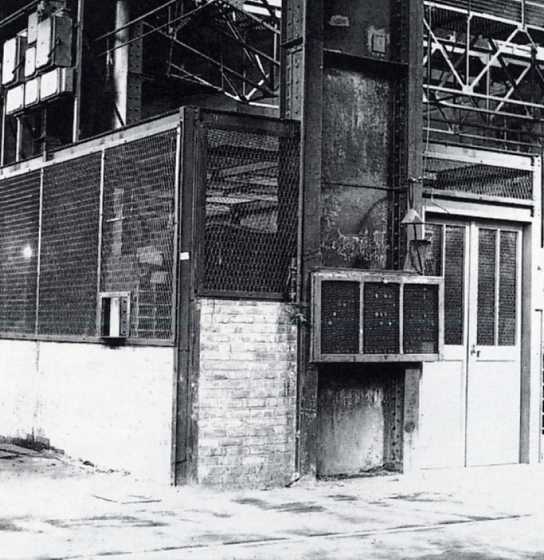
The “token box” between the halls B and C
Until the end of the period of the “vapor”, the work conditions in the workshops are rather hard. Of course, one cannot generalize with the whole of the workshop. With the workshop of the clockmaking, where the adjustment of the instruments claims a certain meticulousness, one cannot say that work is painful. In the other hand concerning the disassembling of the locomotives, the repair of the large parts and the reassembly, the situation is quite different.
The dismantling of steam engines, in particular their boiler and their pipings, is made in the dust and the soot. This one soaks the coveralls which must be more washed frequently than in the other workshops. But she also soaks the menin a long-lasting way because on returning to their place of residence they " still smell the locomotive ".
The dismantling of the patches of asbestoses around the boilers of 141 R brought as a little of whiteness in this universe. Some were then engaged in real battles short of patches of asbestos without knowing then the high toxicity of the product. (It is only 30 years later, that the lung cancer touches some of these men who had to manipulate the unprotected asbestos, the unconscious of the incurred dangers).
One of the peculiarities of the work on steam engines, tiend in the manual character of the operations. For the transport and the manipulation of the often heavy parts, QM has warehousemen's significant number loaded with these painful tasks.
The dismantling and the reassembly are made with very few tools. To tighten a nut we knock with a hammer on a key, excessively. But what was possible with the mechanics of the steam engine will not be it any more with that diesel. What will make say sometimes in the vapeuristes that the diesel, " that is of the locomotive in sheet steel of 2 ".
Indeed the characteristic of the work on the diesel locomotives will be on the contrary, the cleanliness, the accuracy and the delicacy, the organs being much more fragile. Contrary to the workers of the vapor who have to work with an often very rudimentary equipment, we shall use from now on a better adapted equipment. " Surgeon's box " as will say the former in the view of the multitude of small tools that she contained, will contain among others a torque spanner to tighten nuts in moderation.
Finally the another characteristic of the work on steam engines, it is the noise. It is particularly true to the workshop of boilermaking where works "Choumacs" (workers boilermakers). The sheet steels of the boiler are indeed rivetées in an infernal noise. The team of riveting consisted of a "striker" and of one " content of heap ", became in these conditions quickly a deaf person.
The work conditions will be a little softened shortly after the Second World War by the heating of the workshops to the hot air. Until the war the workers could indeed heat themselves only via braziers.
In these conditions, the implementation of a compulsory annual medical examination for the entire staff was not of the luxury. However some will doubt her real efficiency in the field of the screening because the doctor contented with taking the weight, the tension and with measuring the visual acuteness. On the other hand every three years a car equipped with radiographic devices going to QM to make undergo to the staff of the more detailed examinations in particular lungs. It is besides that after war that the doctor will be permanent in the establishment, what will facilitate the interventions during occupational accidents. The work of this doctor will also be made in the domains of the prevention against the alcoholism and the addiction to smoking.
One of the moments important of the life for QM was naturally the moment of the pay. This one took place twice a month in every workshop, the first one for the deposits, the second for the balance. Every worker, having affixed his signature on a register, receives an envelope containing tickets and parts of coin, which he hurried immediately to count in case of a hypothetical complaint.
Gradually from 1975 this "Ceremony" will disappear with the payment of salaries on a bank account.
If a beginner were touching in 1947, approximately 7000F a month, what was far from salaries offered in the private, certain number of bonuses could come to enrich the basic treatment. First of all there was a "bonus" which consisted of a bonus for the execution in a task in at time lower than that planned. That was the easiest to drop out and the most spread.
The bonus at the "suggestion" was rarer on the other hand. She consisted in rewarding a worker or a team for the development of a new method of work, a new tool, a modification on a machine. The suggestion is examined by the engineers of the S.N.C.F which was to determine of it the relevance and there its operational startup.
As against the salary is reduced for the hours lost during the hours of strikes, which is the subject of negotiation for the staggering of payday withdrawals.
Contrary to the bonuses which rewarded the " good worker ", there was certain number of measures to sanction more or less heavily the " bad worker ". Of the warning to the pure and simple redundancy for grave fault. Any breaches of the regulation, the refusal to execute a work or incident during the work was the object of a demand of explanation by the hierarchy. The worker culprit had to draft a note - known under the name of 7 P 1 - to justify his behavior, what sometimes gave rise to real pieces lyric. The simple delivery of this last one was already considered by all as a penalty.
The evocation of the current penalties to QM brings us naturally to bend over the relations which could exist inside the establishment in particular those between the staff of execution and that of the supervision. These relations are going to know important upheavals provoked by the passage of the vapor in the diesel but also in a general context of evolution of the French society where the notion of austerity tends to become blurred.
At the time of the vapor, the worker is above all a performer. The place of the supervision is omnipresent. The expert is the symbol of this period. The work indeed requires expert's presence to determine the part to repair, and its time of repair. With the diesel this structure, archaic and heavy, disappears. From now on every worker determines and judges if a part is to repair or not. Its status thus evolves towards a bigger autonomy and a recognition of its skills. It is the end of the worker used as simple performer.
To QM the basic unit is the workshop. In the time of the vapor every workshop has his own organization, its own estate management. However for the worker, his universe stops in the door of the foreman.To speak with him, it is necessary to deposit a request at the guichet of its office. But the worker rarely has to address the foreman, his privileged interlocutor being his team leader who is for the contact of the realities of the workshop. On the other hand the foreman, in spite of his title is rarely in workshops, what does not prevent the discipline from reigning.
With the arrival of the diesel, the things change. The organization is relieved. There are in the workshops only the services of production. The hierarchical pyramid grows shorter. Finished the time of the assistants foreman, second-in-commands of technical teams. From now on the foreman becomes approachable, and one can approach in the workshop. The atmosphere in workshops is thus more relaxed, less strict.
An illustration of this change of the rules of life in the company can be observed in movements within buildings. At the time of the vapor a worker could be brought to fetch a part in another workshop than his. If he was surprised in full discussion with another worker it was then asked by the supervision, to return at once to its workshop.
With the conversion in the diesel is set up in the workshops of self-service stores for spare parts. Regularly furnished he puts near the posts of work all the parts necessary for the repairs. It is thought that the movement will decrease. In the practice, these will always take place with the difference that the supervision will play less the police. Every worker being responsible for his acts and especially for his working schedule. The relations between former and young improve.
If, at the time of the vapor, the “seniors” jealously kept their knowledge with respect to the young people and played the “caïds”, the arrival of the diesel puts on the "same equal footing", young people and seniors for the knowledge.
Environment in the workshops improves. But, the relations between the staff of the workshops and higher part of the hierarchy do not evolve and remains cold. This hierarchy is indeed composed of two groups.
The first, is resulting from the “heap”. I.e. of the railwaymen of QM which climbed the levels of the hierarchy and consequently which is known and recognized by all.
The second group is composed of technicians resulting from the universities, therefore not of the world of the railroads, and which are employed with QM for one relatively short period.
They do not have time to be integrated into the company, and cannot seize all the characteristics of them. This group is not recognized like integral part of QM, from where a certain incomprehension on both sides.
It is a tradition with QM, which comes can be workers' guild which reigned during the construction of the railway lines in France, which consists so that the agents have a nicknames.
Perceived during a time as a way of depreciating the notion of head, the practice of the nickname is extended then to the whole establishment. It is a time at QM where people did not know by their patronymic but by their nickname. This one, deducted by a physical or behavioral peculiarity of the individual, accompanies the worker during his career and to his retreat.
Too bad for the one who had to carry all his life a little flattering nickname without being able to get loose from it. The list is long and it would be physically impossible to quote them all here.
Suffice it to mention a nickname, leaving the reader to imagine their origin.
- The slug, the dumb, the kiss that kills, pissing everywhere, spring mouth, nose leather, the gondola, serine, big pussy, pussy, sausage merchant, sister smile, blink, the "maqueu" of chalk, poustiquet, etc. ..
The description which we have just made would not be complete if we did not evoke here the world of the offices the staff of which represents about 20 % of the total staff of the establishment.
The life of the employees of offices is very different from that from the employees of workshops. Beginning the morning one half an hour later and in the finishing evening one half an hour later the staffs never cross themselves. In offices, no boxes with tokens, it is the office manager who notes the absences and the delays. Each preserves the town suit, contrary to the workshops where the workwear is compulsory, and settles down to his desk in the rooms which group together about ten persons. The desks are arranged in a way that the employees work, the "back turned" at the office manager who oversees of its place the work of her subordinates men and women. The specificity of offices is the presence of feminine staff, the presence which does not find in workshops.
Seen of the workshops, the offices are nicknamed " the incubator ". This expression symbolizes well the ditch which separates both worlds. Station then to the one who, worker of base, reached by means of the promotions the universe of offices. For those stayed in workshops, the colleague of yesterday becomes a foreigner which in spite of its change of category stays fundamentally a worker. Within offices he is not totally likened as "true bureaucrat" and the port of the blouse instead of the civil costume is not made to facilitate the integration. However offices and workshops are obliged well to maintain certain links. To fetch a form, make sign a paper, the worker has to cross the "Rubicond" symbolized by a "service way" and penetrate into the administration building.
For the agent who enters QM at the age of 20, it is 35 working years that open to him, and for certain pessimists 35 years of prison.(He is certain that the position below the city of buildings provokes a certain isolation which can by certain aspects evoke the idea of prison).
From time immemorial, the new agent, that it is resulting from the row or outgoing of the school of training, begins its career at the sides from an experienced blue-collar worker. For one more or less long period the new railwayman is trained by the observation and the practice of the work for which it was recruited like with the compliance with the fundamental safety regulations, into force in the workshops of the railroads. Once he is considered to be ready to only manage, he becomes autonomous.
Its career can then start. Entered like as "simple blue-collar worker" that Ci will be able to cross more or less a large number of hierarchical levels.
At the time of the vapor it is all the more easy as the hierarchical pyramid is high. The bottom of this hierarchy being made up many laborers and unskilled workers. The mode of rise is done by the means of written and oral examinations. Thus each one has, according to its personal possibilities and its efforts, the means of reaching the highest stations and in particular for those resulting from the workshops to finish in the offices (supreme dedication). Thus apprentices, like Michel BLAVETTE, Léonard RIZZA, Daniel BARRE, have reached the function of Chief of Establishment to Quatre-Mares
However with the arrival of the diesel the things change . The company does not need more labourer simple. It needs qualified people. And if it is not the case, at least people having good concepts of mechanics or electricity. With conversion, the hierarchical pyramid tends to become lighter. Many intermediate levels are removed what results in a reduction in the positions of power, from where less opportunities for climb in a high number of levels. Finally in 1992 the mode of rise within the company is modified. The promotion via the equal examinations, where an union delegate and a framework were present at the oral examination, is removed to be replaced by the selection criteria and of seniority within the company. .
If the system can be questionable for certain, it however has the virtue for the new foremen of QM not to more be obliged to become an expatriate during 2 or 3 years in another establishment of the company to perfect their knowledge as that was the case with the old system.
© GAQM2016 joel.lemaure@outlook.fr