HISTORY OF WORKSHOPS OF QUATRE-MARES


THÈME XI
THE WORKSHOPS AT THE DAWN OF THE XXI° CENTURY
The modernisation of the BB 66000
The reorganisation of the services
At the dawn of the 21th century, Quatre-Mares is maintained in its role of guiding workshop of the diesel-electric locomotives of major power (2000 in 3600 horses). He always insures the directorate, the study of the modifications as well as the follow-up of locomotives BB 68500, BB 72000, BB 72100 and BB 67000.
At the beginning of 2000s, the park of the diesel locomotives of the SNCF became ageing. Since 1975, date of the delivery of the last BB 67400, no command of new machines was realised. This in spite of some projects which, although promising, were given up for financial reasons.
Indeed, throughout the 80s, essays will be led on diverse prototypes (BB 10003, 10004, 20011 and 12) to use three-phase engines (asynchronous or synchronous) on the place of the traditional engines with direct current , expensive in interview(maintenance).
In 1990, Alsthom will obtain from the SNCF the loan of a BB 66400, the 66480, to experiment a chain of asynchronous drive intended for diesel locomotives built for a foreign network and for of possible BB 73000 who will never be built.
Modernize the park, becomes however an authoritarian necessity. A call for tender is published in the "Journal officiel des Communautés européennes" in October, 2000. He concerns the delivery between 2003 and 2006 of two categories of locomotives:-55 locomotives "mono-cabin" of power averages 1200 at 1800 kW) for the routes of average distance, with performances comparable to those of the BB 66000 and BB 67000.
-69 locomotives of major power bi-cabins intended for the trailer of long trains. The power of these replacements of the CC 72000 would have been understood between 2250 and 3200 kW.But the capacity of financing of the project shows itself too low, in particular in view of the prohibitive cost of locomotives "CoCo" (2 bogies of type "C", with an engine of drive by axle as (CC 25000), the call for tender is cancelled.
A few months later, a second call for tender is thrown. He rests then on the idea of a park "multifunction unique" , of power intermediate ( 1800 kW) and a close relation of the existing locomotives. These exploitable machines in multiple units would offer a lesser cost price, because more easily available. The new offers are handed in November, 2001 and technical meetings take place during spring, 2002.
The BB 75000
In February, 2004, a contract is signed with a consortium which gathers "Alstom" and "Siemens". While the previous project concerned 124 machines, this one concerns 300 locomotives BB75000. Project to which is added an option of 100 additional machines according to the situation. that would allow to reduce considerably the mean age of the diesel park of the SNCF.
These locomotives of intermediate power (approximately 2000kW) present a close silhouette BB 37000. In fact, the mechanical part is the one locomotives of the family PRIMA of Alstom (as the BB 27000), whereas the chain of drive is signed Siemens.
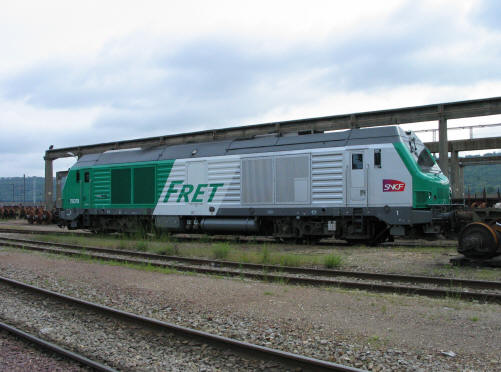
The BB 75079 in the court side “Rouen”
It is during the year 2006 that the first BB 75000 begins to circulate on the French network.
The BB 60000
At the same time as the project BB 75000, a second command of 175 machines of intermediate power is launched. These last ones are intended to replace, at least partially, the series of the BB 63400 / BB 63500.
The management of the SNCF had to choose between three models: G 1000 of Vossloh, D 146 Trenitalia de Firema and a by-product of Am 841 of the CFF proposed by Alstom-Espagne. After all, it is the proposition of Alstom that is retained. The BB 60000 is commanded.
Although the Alstom factory of Valencia was bought back by Vossloh in 2005, the first machines brought out of chains in 2006 are effectively provided with the patches of this manufacturer, the part management of the project remains however always piloted by Alstom.
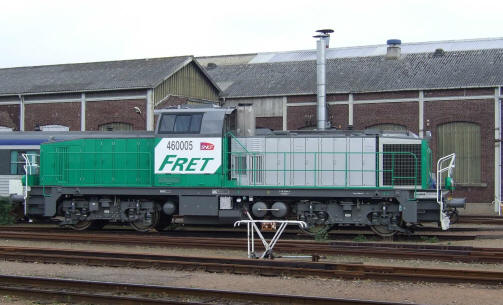
The BB 60005 in the EM "Normandy"
The BB 60000 derives directly from the series 311.1 and from the prototype MABI of Renfe (national society of exploitation of the Spanish railroads). But, unlike these basic series, the manufacturer wished to replace the engine MTU by an engine Caterpillar. They are equipped with the systems RSO, VA, KVB, Daat, RST, bimode, Atess, radio of laborer and pre-equipment of the remote control.
Useful in "multiple units", the first BB 60000 was allocated to the EMM of Normandy to Sotteville lès Rouen for the service on " Havre, Sotteville and Mantises ". Some are distributed on the Paris region. Their affectation on the other regions is subjected at their charge by axle.
The modernisation of the BB 66000
While waiting for the delivery of these new series of locomotives planned from the end of 2006, a modernization of the BB 66000 with installation of a new diesel engine is studied. Less expensive than the purchase of new machines, this solution allows to make a transition gently, since the new machines (BB 75000) are not intended for the same services. The transformations concern only the third slice of BB 66000, delivered between 1965 and 1968.
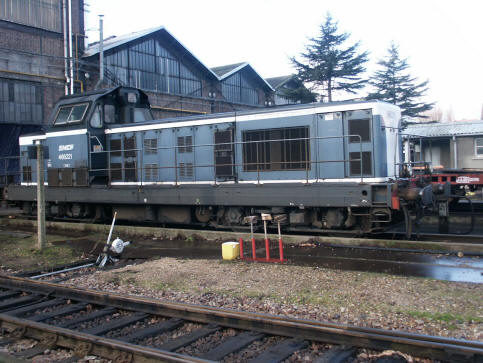
69221 before the repowering
From 2004, Quatre-Mares takes care of the repairs and of the modernization of this series. The objective is to join the environmental policy by the implementation of a new motorization on this series of locomotive. What will allow to reduce considerably the discharges in the atmosphere of the toxic particles inherent to the use of dilapidated and greedy diesel engines. A new generation diesel engine, made and worked out by the German motoriste MTU, brings a solution.
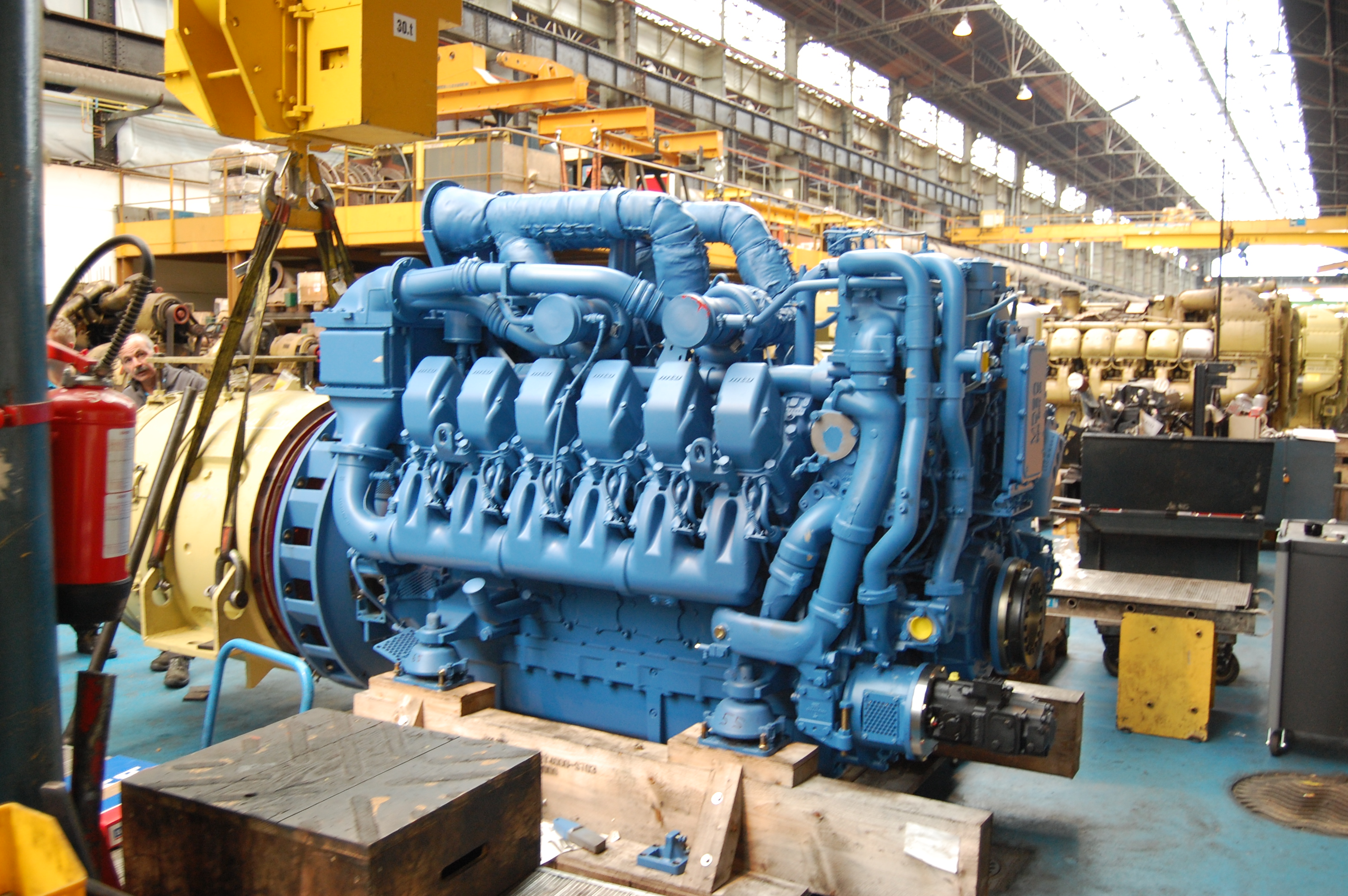
The installation of the GP of origin on new engine MTU 12 V4000 R41
To avoid confusion with the two prototypes BB 69001 and 69002 which were written off in 1984 (see Topic IX), the designation of BB 69200 is often preferred to that of BB 69000, although it does not correspond with the numbering rules applied since 1985 park or reality (the numbers start at 69191).
The BB 69000 are used jointly with the BB 66000 (with which they can always function in multiple units) in service "merchandises", or at the top of trains of work.
The machines modernized for the "Fret" activity, receive their livery "green, white one and gray" which already exists on the 66000 classical. The first units transformed for the "Infrastructure" activity were painted in the livery "blue", similar to that which is applied since the end of the Eighties. The others receive a news livery "yellow" with gray and mauve motifs.
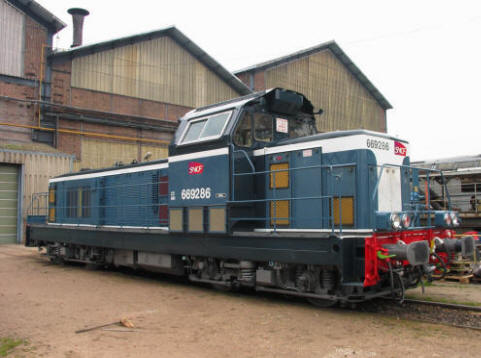
The "Blue" livery of the 80s
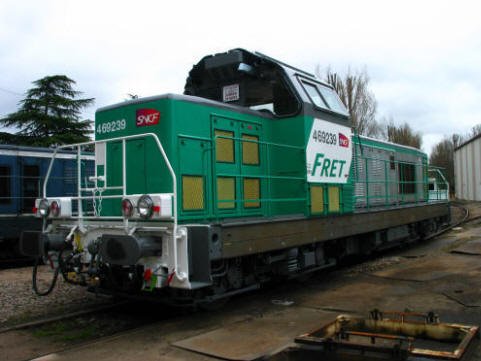
The "Green" livery for machines "FRET"
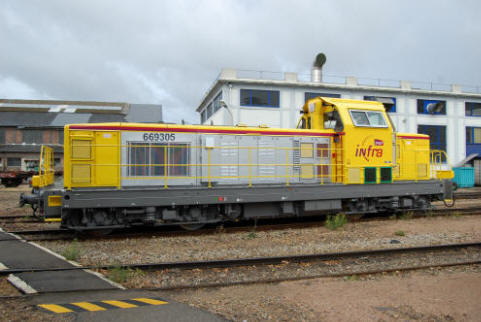
The "Yellow" livery for machines " INFRA "
The BB 69000 and 69400 were born. The two sub series being are characterized by the fact that one is equipped with a principal generator (69000) and the other of an alternator (69400).
Find the photographs of the various phases of modernization while clicking: Here
In 2005 the "directorate" of the establishment extends to series: BB 66000, BB 69000, BB 66700, BB 60000 thus that of the diesel engine of the BB75000.
Its main missions are then the following ones:-the revision and the repair of the diesel-electric locomotives and part of the organs which constitute them,
-the writing and the evolution of the rules of maintenance, the technical studies,
-the study of the modifications, the follow-up of the Diesel locos and electric,
-the follow-up of the quality of service of these engines,
-the supply of the establishments of maintenance users spare parts,
-the national formation for the nondestructive examinations (END) and the formation plastic are ensured for the whole of the SNCF,
-the contribution of the experiment and the know-how of the establishment requested by outside firms.
................................................................
In 2006, the establishment have gained an international invitation to tender for the maintenance of the Eurotunnel axles for one 3 years duration. (750 axles a year)
.....................................................
In 2007, the transfer of production of the remotorisation of Y8000, makes it possible the establishment to show its capacity as regards respect of the objectives of costs, times and quality fixed by the activity customer: the FRET.
.......................................................
In 2008, the school “Non-destructive tests” (END) received obligatory approval to give the Ultrason trainings, Ressuage and recording of magnetic particle testing of the Railway Public corporation of Safety (EPSF), independent organism.
......................................................
The same year Quatre-Mares becomes the “National Center of Excellence Polyester” and sees its name changing. From now on its designation becomes “Technicentre of Rouen Quatre-Mares”.
© GAQM2016 joel.lemaure@outlook.fr