

THEME VII
THE APOGEE STEAM
(from 1948 to 1963)
Reorganisation and steam production
Some reconstruction work are completed
during the years 1948 to 1950, after being suspended booming due to restriction
of credit.
This is the case among others for finishing outdoor tracks, the resumption of the interior floors of workshops, construction of changing rooms, wash basins and showers, the completion of the halls and windows of the gable of boiler iron side Rouen.
In October 1948 the apprentices return to QM. The tradition of the"GR" locomotive left to third year students is thus found again. The buildings of Jumieges, vacated, will redeemed by the town and turned into rental units.
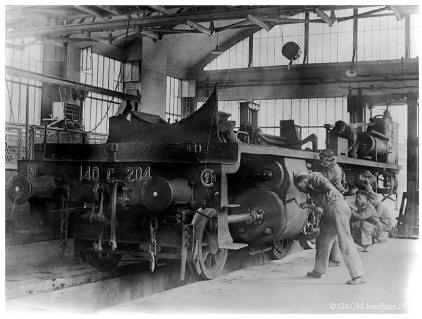
Apprentices on the 140 C 204
The equipment destroyed, outdated, or sent to other institutions, is gradually replaced by new machine tools with high performance. The latest methods of machining (cutting negative, grinding) are introduced to QM.
If the role of workshops of "Quatre-Mares" is the same before the war, there are problems, both technically and in terms of personnel, on resumption of the activities to QM.
The disparity between the salaries offered by SNCF and those of private industry has resulted in numerous resignations. Excellent items are replaced with the unskilled labor, which must then train and introduce at the technology "locomotives". This handicap represented, by the shortage of Boilermakers Iron worthy of the name, is a serious constraint to the activity of Quatre-Mares.
However the various productions of the workshops are presented rapidly with a quality at least equal, if not superior, to that of 1938. The finishing and machining precision that characterize it, are obtained thanks to the possibilities of the modern equipment of QM.
The staff of direction of QM again sees evolving his organization over the years. The services we have detailed in the organization before the war are not only changing their names but also their responsibilities. It's under the names of services TR, TM, and TO, that they will be organising, from the 1950s to 1960s, the workshops of "Sotteville Quatre-Mares".
Throughout its existence, QM will not have of cease only to improve quality of its production and to reduce downtime , as well as the cost prices, as well from the technical point of view as from the Personnel point of view.
If the first machine, exit of "great revision" after the release in March 1945, is released after 75 days of immobilization, due to the constant supply difficulties, all the machines passing in GR. are quickly treated uniformly in 35 working days.
The locomotive makes its test of functioning the 32 and 33rd day and is delivered to the deposit, the 35th day in the same conditions as the pre-war year. It is important to emphasize that everything is done to these deadlines are strictly adhered to. They are very much reduced at the return of "General Store" of SOTTEVILLE, moved at THOUARS. The difficulties of the connection with the latter were indeed the cause of frequent delays in the delivery of essential parts.
In 1950 the locomotive is delivered to the deposit after 30 days of immobilization. In 1960, she is at D + 28, in 1963 at D + 25, and at D+ 21 in 1965. Obtaining the best cost has always been the concern of the workshops.
The "Pacific" which, in 1945, require 14 to 15 thousand hours of work, count only 12,000 on average of 1949 to 1955 .This will be achieved by a careful disassembly, greater expertise, and improved methods of repair ( the time reductions allocated intervenes with the introduction of work processes and new tools). This effort is pursued constantly by moving closer to the maximum potential of the workshops.
The 141 R et 241 P
Like most of the locomotives that come in review at "Quatre-Mares", many improvements are made on the 141 R.
We will not extend here on the few 300
modifications from unequal importances which were lavished on the 141 R coal and
of which an about sixty related to the boiler;nor those made on the R 141 fuel
that were consisted a very important modification of the boiler, and were
conducted between 1956 and 1964, during lifting with test in workshops of
Quatre-Mares and at Nevers.
The book of Bernard COLLARDEY and André RASSERIE entitled " 141R ...... these brave Americans ", is for these locomotives a reference of the most serious. If, generally, the establishments “leveurs”, deal the machines of their area of membership, some have an interregional vocation. In the establishments of Nantes-Blottereau, Thouars, Rennes, St-Brieuc, as in that of Sotteville-Quatre-Mares, which were charged on several occasions with the machines East, South-east and R.M., six to eight machines and their tenders are in hands simultaneously. At the time of the crisis of Suez, at the end of 1956, "Quatre-Mares" is seen charged, contrary to the service of the workshops of Nevers and the Western deposit of Niort in 1947, to modify twenty locomotives heated by fuel, for heating with coal.
These are the 141 R 965 and 985 of Avignon, the 141 R 970 Miramas, the 141 R 991, 994 and 1020 in Nice, the 141 R of Mézidon 1039, 1260,1264,1265,1273,1276 and the 141 R 1278 Le Mans and the 141 R 1261,1272,1285,1288,1294,1296 and 1297 in Rennes.
A the reform of the 141 R, recovery of these actuators of marche change, in order to install on the 241 P , replacing the original system screw.
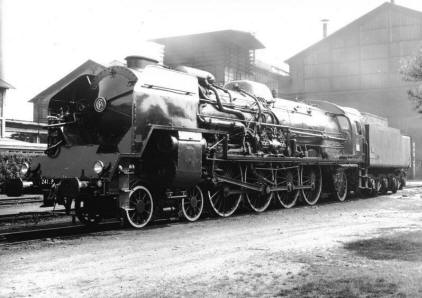
The 241 P
The first 241 P , built in the factories of "Le Creusot", is delivered to the Region "South East" in May 1948. An order of 35 new units is launched by the S.N.C.F. She considered insufficient the manpower of machines ready to ensure the trailer of heavy trains (600 to 700 tons), at speed raised, on lines with difficult profile, in particular on the South-eastern area.
Not new, this machine is actually a revision of the 241 C (PLM)., with the latest developments in the field of steam locomotives. After hunted of their lines a part of the cavalry of the "Pacific" (fast but not very powerful) and after assuring brightly relay, without breaking bulk, of the electrics locomotives , they in turn are gradually driven from their region due to the development of electrification.
For example, the 241 P 31, on his release from "Quatre-Mares" in December 1958 began a new career, on the east network , and we can also to seen in the early 60s, a 241P at the head of a "Le Mans - Brest."
After forty eight years of activity Vapor, the
workshops of Sotteville Quatre-Mares will have handled in revision 4025
locomotives among which the types varied as well as the series, cover a rather
impressive beach of locomotives, going of 220 to 242 A1. That is to say
ultimately about fifty types of engines.
The decline in activity Steam
The days of steam will be sadly counted from the
early 50's. Indeed, despite all the improvements made to the steam engine to
increase performance, it is clear that the operation of this mode of traction
both in terms of fuel used for drivers and maintenance is a very expensive
operation.
The policy of the SNCF, after the Second World War will therefore focus on cost savings by modernizing the way of traction. Its aim is to gradually replace by the electric traction, the steam traction. This choice is dictated both by technical constraints and the country energy policy.
Indeed, we see that for the same distance, here where it takes 1 ton of coal for a steam engine, it not takes more than 77 kg to produce the electricity needed to advance an electric locomotive.
France is becoming increasingly conscious of the limits of its coal resources and the financial burden posed by imports of this fuel. The country's energy policy, which will dictate the choice of the SNCF, is turned to a better use of coal available for power generation in thermal power plants, but also a greater independence vis-a-vis foreign by the hydropower development. However for the S.N.C.F., it is not technically possible, nor financially profitable of electrify the whole of the network. In the first time, only the broad outlines are equipped. The secondary lines and of maneuvers, for their part, are exploited by Diesel locomotives. However, the fast progress made in this type of motorisation allows the extension of these machines on the whole of the lines
Were finds first the diesel locomotives at the maneuver and for the freight traffic, and from 1955 on the types of traffic and on the areas more extensive. The exploitation of the diesel allows to divide by two operating costs with regard to the vapor. Until the oil crisis of 1975, which saw a surge in oil prices, the diesel machine appears as the ideal machine and economic to replace the steam until a hypothetical general electrification of the French network.
The decline of the activity Vapor is then translated, to the workshops of QM, by a progressive decline of the annual number of locomotives entering for "Great-Revisions". A new era was born and the release of the AIA-AIA 68001 in November 1965, the first diesel locomotive revised in the workshops of Quatre-Mares, proves it.
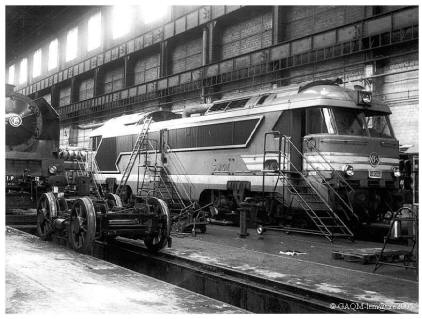
The A1A-A1A 68005
Deliveries in August 1964 of the "Pacific" 231 D 727, in July 1966 of the 141 TD 121, in June 1967 of the 241 P 16, and finally the 19 March 1968 of the 141 R 1272, the last steam locomotive treated, closes half a century of activity devoted primarily to steam.
Sounds then the knell for steam locomotives, their slow routing towards the places of destruction, on diverse points of the territory, begins. The load represented by the other types of interventions, such as the simple liftings or with tests of boilers, will not be enough for a long time to maintain staff and will bring the direction of the S.N.C.F. and the establishment to look for palliatives to this situation.
The additional works and the prototypes
After the last liftings of steam engines and in the preparation or repair of
spare parts, is then added of numerous preparations of series, sometimes also
prototypes.
So from 1950 till 1954, the workshops of QM, although they have not vocation of
manufacturers , are loaded with the construction of 2 prototypes. the 030 DC1
with a single engine overfed Renault 565 and 450 CV enters the category of the
locomotor. And the 030 DC2 (become C60002 in 1957), equipped with two
atmospheric engines Renault 517 (identical to that of the ABJ and of certain
Picasso) and a developing 600 CV, enters in the type of the locomotives.
These prototypes have served the searches in the motorisation and the development of the coupling of the limps with transmission " CEMFAR " which is a permanent concern. They will be essentially used on the star of Alençon in the drive of Fret local train. If the career of the first one is short (25700 km) we can note that the second has assured its service after many adventures until 1963 date of her reform.
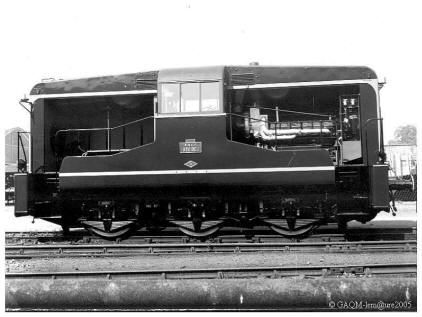
Locotracteur 030 DC1
Although these machines did not give complete satisfaction, this realization will allow at the workshops of QM, between 1953 and 1956, of obtain the responsibility of the construction of 18 locomotive which will have for numbering, Y-9100 and Y-9200.
These series will be renumérotées Y-51100 and Y-51200 in 1961. These machines which weigh 34 tons and which are respectively equipped with engine Renault 565 and Saurer SBD, as well as of gearbox VOITH, develops a power of 400 CV for a 50 kph speed. The reform of these locomotive will begin during the second half of the 70s and will be enclosed in December, 1984. With these reforms, the category "Locomoteur" is not any more represented within the park of the SNCF. Several units were sold to companies to serve on linked up terminal installations.
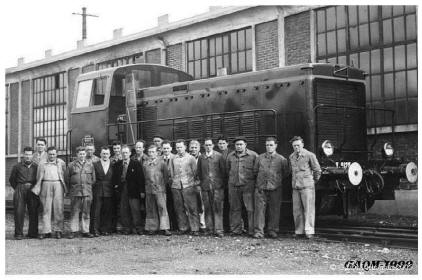
Y 9125
For these constructions QM, such a builder, saw itself endowed with specific equipments working in lines of steady manufacturing. It is during these years, that is organized a chain of modifications and of reinforcement of the extremities of cars "O.C.E.M.". She allows the realization of 40 extremities on average a month.
In addition to this work: a review of bridges railcar engines for workshops of Le Mans, the manufacture of railcar-axles Renault ABJ3 complete, restoration of a monument in Gare du Havre, the making of a machine to soak the springs for workshops Buddicom, and that of a shot blast machine the springs and the construction of prototypes of bogies for the car-tilting coming and at this point at the study.
It is in 1956 that, starts at Quatre-Mares, the realisation of a prototype using the principle of the pendular suspension, for improve the stability of the cars and to make them apt to pass from the curves with the maximum of comfort for the traveller.
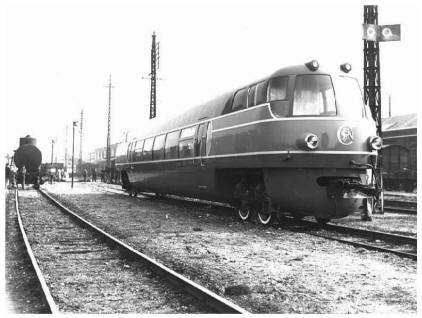
The pendular car with the deposit of Sotteville
This car is presented Tuesday, December 3, 1957
at many members of the press, of the radio, of the television, and the film
newspapers. Towed by an electric railcar it performs the route via Paris to
Montereau Héricy and return.The 130 kph speed is supported between the PK 65 and
70 and 75 and 89 on the section of line Melun-Montereau, on which the speed of
the way is normally limited to 100 kph because of the presence of curves from
500 to 600 meters of beam. The hosts of the S.N.C.F can
then estimate the stability and the excellent holding of the car which avoids in
particular to the travelers of the very unpleasant and uncomfortable effects of
the centrifugal force in curves, to the high speed.
The year 1957 sees the construction of tip trucks chargers and semi-fixed devices ‑ for trailers rail‑road. Tests of sound-proofing are carried out on a Y9100 locomotor. One manufactures this same year with QM of the reinforcements for the viaduct of MIRVILLE. It is also proceeded to the revision of the transporter bridge of the deposit of Le Havre. Then in 1960, at the construction of bogies Y 24 and the industry of spare parts for Jqhor wagon, it will be the launching of the production line of vans boilers starting from vans “1896”.
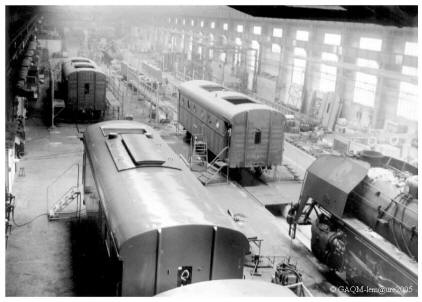
Construction of the vans boilers
Then in 1961 the preparation of a tree carries helix, of pylons of 30m for the service "VB North", as well as of pylon of lighting with seesaw.
© GAQM2016 joel.lemaure@outlook.fr