

THEME IX
DIESEL-ELECTRIC LOCOMOTIVE OVERHAUL AND REPAIR
(from 1972 to 1995)
The diesel electric locomotives
The series of diesel-electric locomotives revised to Q.M.
The diesel-electric locomotives
Why to have given this name to a locomotive? We are going to try to develop most simply possible in this chapter, the principle of functioning of this type of locomotive who rests in fact on two elementary and specific notions.
Everybody knows the principle of functioning of an internal combustion engine which consists in transforming the linear movement of a piston into rotary movement.
There are two types of this engine. In the first, the gasoline engine, we introduce in the cylinder a mixture dosed of air and gasoline which, during the following race of the piston, is compressed, before being inflamed.
In the second, the diesel engine, It is of pure air which is allowed in the cylinder, then compressed. The fuel is injected in the cylinder at the precise moment when we wish that begins the combustion of the mixture constituted by this fuel and by the air beforehand compressed.
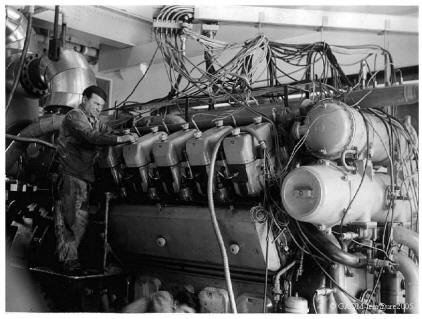
Sulzer engine 12 LVA24 , equipping AIA AIA 68000
The overeating of the diesel engine is used for a long time in the S.N.C.F.. His purpose is to increase the power of engines without increasing their dimensions and to allow so to accommodate in a limited volume the most powerful possible engine. His principle rests on two basic notions. It is necessary 15g of air to burn 1g of fuel and the weight of air contained in a volume " V " is a function of its pressure. If we admit of the air under pressure in an engine of given capacity, it will thus be possible to burn a superior quantity of fuel. Gold, the fuel represents the energy thus the power. To obtain this result, exhaust gases, which keep a residual energy, are directed towards the wheel of the turbocompressor which they entail. This turbine, propped up on a tree of connection, entails a compressor itself propped up on this tree. The compressor, of centrifugal type, aspires the air to the atmospheric pressure and sends it under pressure towards the collector of admission of air of the engine.
The diesel engine cannot, as the steam engine or the electric engine, start in load. It is necessary, to provoke the starting up, to make it turn artificially until he turns over a minimal regime which we call " the slow motion ". In slow motion, the couple is extremely low, and it is only in the nearby speed of its speed of regime that it develops a useful couple. It is thus necessary to connect the engine with axles through a transmission with variable reduction, which allows to make turn the engine in a speed of regime (1500 tr / mn, if this engine is conceived for this nominal speed), whatever is the speed in which the vehicle rolls. It is the transmission which assures the functions which we have just defined.
In the case of an electrical transmission, such as that used on high-horsepower locomotives revised four-Mares, the diesel engine is mated to an electric generator (continuous or alternate).
The current produced by this generator feeds, with a variable tension, engines of traction attacking the axles directly. The MT being fed in D.C. current, it is necessary to use a rectifying block when the generator is an alternator.The Diesel-electric locomotive is, in a way, a producing power plant of current attached to an electric locomotive with direct current.
The return, although a little lower than a mechanical transmission, remain nevertheless about 80 for 100. The Electrical transmission has the advantage of allowing to have the full power of the diesel engine over a very wide range of speed range. This transmission system leaves great potential in terms of installation and weight distribution, since the connection between the generator and motors is via cables. The use of locomotives in multiple units, that is to say the use of multiple locomotives coupled and driven by a single agent, is a particularly simple solution in this case of transmission.
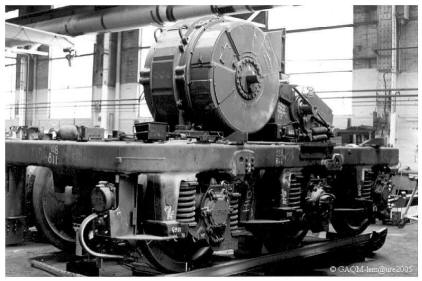
bogie of CC 72000
If, instead of the return on the diesel engine, that we shall not develop here, we consider the return in the hook of drive of a diesel locomotive, we notice that that of a diesel locomotive with electric transmission is approximately 4 times upper to that of the steam locomotive. The diesel drive thus presents, from the energy point of view, certain interest. Furthermore with regard to the steam engine, the machine of present diesel drive the advantage to escape all the subjections of preparation, as well as the necessity of a periodic provisioning in the course of route. The taken reserve of fuel allows an autonomy about one thousand kilometers.
The series of diesel-electric locomotives revised to Q.M.
The park of diesel-electric locomotives, whose the Workshops of Quatre-Mares have in responsibility the revisions, represents in 1995 a staff about 785 machines.
QM is designated as a first step, Guiding Workshop of the " AIAAIA 68000 and 68500 ", " BB 69000 " and the " DC 70000 " to which will be added quickly the " BB 67300 and 400 " as well as " CC72000 " and " CC65000 " then, in the 1980s, the " BB 63000 ". The appointment of "Director Workshop" in fact makes the establishment responsible for everything that is related to the series that have been awarded by the "Directorate of the material" of the SNCF. So, besides the revision of these locomotives, all which touches closely or remotely these series, such the filing of drawings, the elaboration of documents necessary for the revisions and the maintenance of the various essential parts, are the prerogative of its services. However, he is not the holder of these locomotives. It is the deposits for reasons of traffics, infrastructure or geographical situation that receive them in endowment.
These locomotives are named to the SNCF by a number composed of a series of letters and numbers. The letters which precede the number in the series determine the number of driving axles by bogie (so that A=1, B=2, C=3). As machine rests on bogies two these letters are doubled. If a figure is inserted between two letters, it is the case in particular A1A-A1A 68000 and 68500, he represents then the number of carrier axles.
As we noted in the preceding chapter, it is in 1965 that the first A1A-A1A 68000, enters in revision with Q.M. This series, constructed between May 1963 and July 1968, is the fruit of studies which had been conducted since 1960 by the SNCF and which related to the construction of a type of locomotive of 2600 CV. The first 4 machines (there will be of them finally 80) will be equipped, of origin, of engine Sulzer V12 LVA 24. However, contrary to its counterpart, the fifth will be been endowed of an engine A.G.O.V12. D SHR. It will receive the n° 68501 and will give birth to the series “68500” (29 machines). Of the type"A.1.A-A.1.A", his weight is distributed between axles in the 18 ton quantity by driving axle, to assure a good adhesion, and of 16 tons by axle porter. A device, removed in 1967, allow to lighten from the porter axle up to 20 tons per driving axle in order to increase the adherent weight where necessary.
They are conjugable between them, as with the locomotives BB 67000 which we will see further, i.e. who it is possible to twin them while preserving only one control desk and to thus allow control with only one agent.
After having marked the beginning of the transition from the “Vapor” to “Thermics” on trains of line, these machines have ensured of the very diverse services. To assure the heating of passenger trains, they will be equipped with origin with a boiler " VAPOR " fed by a reserve of 4700 liter water. The disappearance of the material towed with heating vapor, and the delivery of thermal locomotives with alternator allowing the electric heating of trains will entail on one hand the disappearance of the series at the head of travelers trains and on the other hand, the removal of boilers.
At the end of 90 years, their number will decrease. Their scheduled destruction will take place gradually. At first they will be used to haul the train freight and the trains to works on the proposed new line.
.jpg)
La AIA AIA 68001
In the months that followed the arrival of the 68000 first , QM receives the charge of two new series. It acts, in fact, of 2 prototypes built in double specimen in 1964 at the request of the S.N.C.F. These prototypes had answered the program that the S.N.C.F had fixed in collaboration with the S.F.A.C (Company of the Forging mills and Workshops of Creusot) for the BB 69000 and Alsthom for the CC 70000.
The firsts, built in two numbered specimens 69001 and 69002, are put in service respectively 02-04-1964 and 18-04-1964. The principal characteristic of these engines is to receive in their bogies, of hydraulic boxes V0ITH to replace the electrical motors. They have, thus, two diesel-hydrauliques groups developing a total power of 4080 CV to 1500 rpm.
The role of these prototypes, for the SNCF, will be to test this kind of transmission and to explore them limits . The machines will eliminated the 23-01-1984, after having rolled 1,367,298 km for the first and 1,561,034 km for the second.
Constructed, too, in duplicate, The CC 70000 contain an alternator "birotor" coupled on two engines, opposite with face. Acting the other way around on every rotor, the electric power so produced will be, for a rotation speed of the engines of 1500 t / mn, of 4800 CV. Their bogies had only a single engine of drive completely suspended attacking their three axles by a train of gearing with double reduction. The 70002 had, moreover, the possibility of changing reduction into walk. Their existence will be short since the CC 70002 will be erased a little more than six years after its commissioning, the 20-11-1973 having traversed 613,145 kilometers. Its binocular, the 14-11-1983 with, the meter, 1,224,531 kilometers. The CC 70002 will be presented to the international exhibition of transport of Munich from July to September 1968.
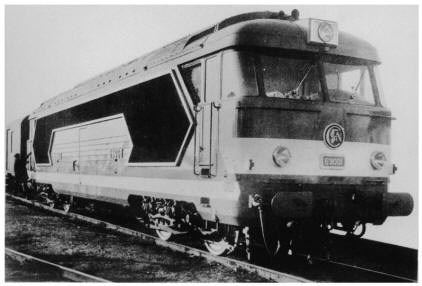
BB 69001
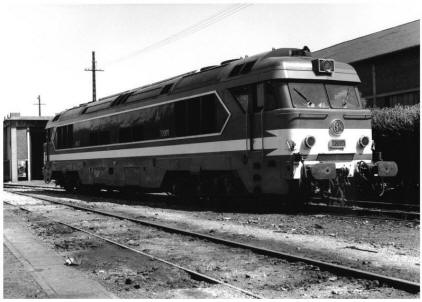
CC 70001
On the technical plan, these machines constitute remarkable realizations. However the problems bound to the supply of certain parts and to their complexity,oblige the S.N.C.F. at give up these prototypes which on the functional plan have giving any satisfactions.
Jointly in the conception of 68000/500, the studies and the technical progress in the field of the diesel engine will give birth to another type of locomotive of 2000 ch, the BB 67000.The Nevers workshops are designated as "workshop-director" of the series built between 1963 and 1968. These locomotives are equipped with engine Pielstick to 16-cylinder V. Of type BB, their bogies presents a new arrangement in diesel drive. Both axles of the same bogie are moved by the same electric engine. Originally, he contained two reports of reduction, corresponding the one at the speed of 85 kph, the other one to that of 130 kph. This possibility will disappear in 1983. The obligation not to exceed a 20 ton weight by axle does not allow to install on this machine a boiler as on 68000/500 or CC 65000.
The heating of trains will be provided by a van-boiler. The BB 67036, renumbered 67291 , will serve as a prototype for the series of BB 67300, and will take afterward the number 67390. The BB 67201-67246, are born of the transformation of BB 67000 in the walls of workshops Nevers from 1979 to 1989. They will be equipped with "cab signaling" to be assigned to rescue trains TGV lines.
19 others 67000 will then be transformed into 67300. It is difficult for an uninitiated to differentiate the BB 67000 of the BB 67300. Indeed, if these last ones, built between 1968 and 1979, have kept an outside shape identical, they benefited from some modifications in their principle of functioning and in their technical characteristics. So the main generator producing the electrical energy was replaced by an alternator bringing him, besides a considerable gain of power, the heating electric of trains.
The workshops of QM assure of 1972 to 1980 the revisions of the BB 67300 and the BB 67400. The first BB 67400 is put in circulation in July 1969. Derived from the BB 67300, they are, like these last, intended for the trailer of the trains of all natures. Its principal differences with the BB 67300 consist in a model different of bogie, and an increase in the delivered power. The burden-sharing between QM and Nevers brings the change of site of revision of the BB 67300 to the profit of Nevers at the end of 1980. Quatre-Mares keeps the maintenance of the series of the BB 67400 and leaving at Nevers the load of the BB 67000.67200 and 67300.
Gradually, the orientations in electric diesel revision of locomotives, will evolve.
In 1992, the closing of the workshops of Bordeaux are decided, QM recovers, after a new burden-sharing, the 67300 of Nevers. The direction of QM calls on a cabinet private council, with for objective an increase in the productivity or fall in the cost of repair in the engines in 20%. This in order to deal with the totality of the park of the Pielstick engines 16 PA 4 of series 67000/200/300 and 400.
This decision is badly perceived by the staff of the establishment, which sees of an evil eye that one calls into question his professionalism, and causes at the time some disorders. Ultimately the results will lead to the designation of the workshops "Quatre-Mares" like workshop-director of all the series of Diesel locomotives of great powers (more than 2000 Cv).
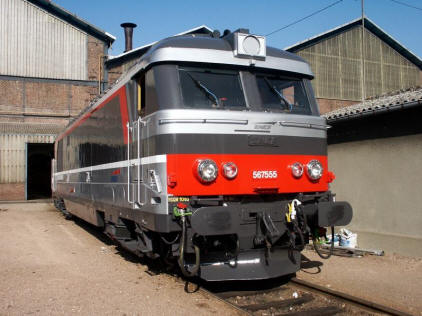
BB 67555
In 1968, born series CC 72000. This locomotive develops 3600 Cv. Like the electric locomotive CC 6500, she is equipped with a system of reduction by gears which as well allows him the trailer of the express trains to 160 km/h, that of the goods trains to 85 km/h. Decomposed into two subsets, the 72001 to 72020 and 72021 to 72092, they are intended to tow heavy trains of all kinds and can be used alone. Although they are both equipped with the same type of bogies, the first series sees its speed limited to 140 km / h, at except of the "72017" that, after a fire, will be transformed and integrated into the second round, limited to 160 km / h.
To assure the heating of passenger trains, these machines are equipped for the heating electric as the BB 67300 and 67400. In 1975, this series assures Fast and express passenger trains at the speed of 140 kph for the deposits of Vénissieux and Chalindrey and 160 kph for that of the Rennes. The Routes in 160 kph have increased, in 1980, with the arrival of cars "Corail" on lines Paris Nantes, Paris Basel, Nantes Lyon and Paris Clermont.
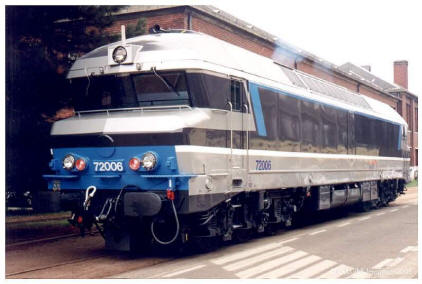
CC 72006
These uses go puting the series in hard test. They will ask the question of the intense use at the the maximum regime. In October, 1982, the CC 72046 is crossed off, following a collision with a third party ( road machine).
The electrification of the Paris Nantes in 1985, will lead to no longer use the 72000 of Rennes to 160, but to 140 km / h, resulting in a change in the maintenance rule.
The electrification of Nevers Paris, in 1988, will lower the average mileage of locomotives Vénissieux, which will lose its fleet in 1989.
That of Grenoble Lyon has the same effect in 1989.
The introduction of the TGV "A", will drop the mileage of 72000 of Rennes.
Overall, the 72000 will make passenger trains 140 and 160 km / h and heavy mail trains. In 5 years the average mileage will drop by 20%. The 72000 of Rennes will transfer in 1992, leaving at Chalindrey and Nevers the entire series.
In February 1971, arrives for the first time in QM, a CC 65000. This particular series,which was the first locomotive cabs-bi of great power, recalls by its form the American models
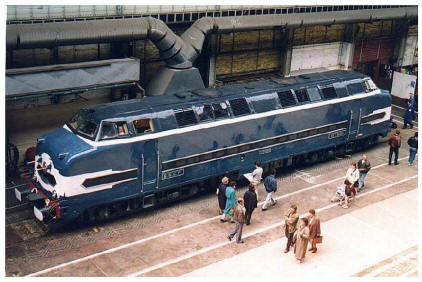
CC 65001
In 1955, the study of the construction of a new series of locomotives that meet the needs prevailed. This service could not be provided by them BB 63000, that we will see a little further, because they did not develop sufficient power. This study was to face various problems. Indeed, for reasons of infrastructure, the axle load of the engine should not exceed 18 tons. In addition, for the trailer to passenger trains, it was necessary to add the weight of a boiler and a water reserve. These requirements led to define the need for a power of 1800 hp. Only at the time there was still no diesel engine capable of providing such power and that has acceptable dimensions in order to be installed in a locomotive.
The establishment of two engines of 925 hp, of type MGO, in the same locomotive will be adopted and will give birth to the series CC 65000 (ex DB 060). These engines, which the revisions are made in the workshops of Nevers had a particular sound, which was reminiscent, some say, that of an apple mill. Built between 1956 and 1958, their bogies were equipped with six traction motors, namely one by axle, to reach maximum speed of 130 km/h. Maintained initially by the workshops of Nevers, Quatre Mares will ensure the revisions as a director workshop from 1972 to 1984. Then, as he had done for steam locomotives, it will contribute to the museum in Mulhouse, in 1994, by restoring the DC 65001.
In the early 1980 Four-Mares becomes director workshop of BB 63000, succeeding at the workshops of Epernay who inherit at the time of BB 12000 and 16500. For the record, it is in December 1950, that the SNCF order at the company "Brissonneau & Lotz", a series of 19 diesel locomotives for branch lines.
The 040-DE-1, future 63001, exited of the factories of Creil on February 1st, 1953. Satisfying the service of secondary lines as well as the service of the sorting and of the routing of passenger trains on short routes, successive commands will be repeated until 1967.
The general revision of this series of machine will be carried out to Quatre Mares, after a fast formation of the agents of QM at the workshops of Epernay. If its design diverts by its ancientness the followers of the modernism, some will appreciate it for the access, easy of outside, at its subsets.
Shortly after their arrival in QM, they will exchange their painting "Green wagon" for a painting "Arzens" more visible. Deemed "indestructible", multiple factors economic contribute Unfortunately, since 1990, to accelerate they reform. Since, in many institutions (Chambery, La Villette, Lens, etc. ..), a multitude of gear, awaiting demolition haunt the ways of deposits while others will be parked in good condition until potential buyers.
At the beginning of 1970s take place the reform of the organization of the S.N.C.F. and the Material which will be called the "Regionalisation".
This reform allowed the implementation of the main structures of organization which are even effective today. The Guiding workshops, the holders deposits , the Organisms, the Groups of Studies, the Technical Services, Agencies etc. are entities which assure very precise functions.
The Study Group of Quatre-Mares is loaded from the start to establish the rules for maintenance of sets of locomotives under his charge. The development of these rules was necessitated by the waves of retirement that followed one another while the young recruits did not know the work. There is an urgent need to extract the technical knowledge of the memory of the former and avoid the vagaries of oral transmission of knowledge ....At that time, the GE makes a lot of documents, many of which remain in a state of local or regional projects. The creation of these summary documents the early 1970's is made with Agents of mastery, selected and transformed into "rapporteurs".
Between 1975 and 1978, a period when many locomotives of QM have their first review these officers will report and note what they observe in the workshop. A great demand for documents is created. Their writings, although very fruitful quantitatively, will not all be validated, although some are still used today. Some of these documents will serve as the training of young recruits in the first months of activity at their workstation. Duplication of work in the teams favor phasing out the use of regular repair sheets except in areas where the technique is sharp or for the operations performed on complex organs. La réalisation des documents d’entretien répondait bien sûr à une logique. Above all it was necessary to address the issues affecting the safety of traffic and the notions of consistency of repair or visit. The collection of documents of maintenance, will organized then around what it was advisable to call documents "hats". They are the, I.T.R (inventory of works of revision) and the I.T.V (inventory of works of visit). They are even today the referential of the necessary works to maintain the material.
All work described in these documents should be made to maintain the potential of a series of locomotives. Other documents called Technical, Repair, or visits, if necessary, specify the work or techniques to use. In the world of transportation, the SNCF has a special status. It builds its own rules for maintenance, is changing depending on the service provided, enforces and provides its own control.
To understand this, simply compare the situation of the SNCF to that of an air carrier:
The manufacturer of a plane elaborates the rules of maintenances which relate to it. The carrier must apply them or make them apply in subcontracting in an approved center. The quality of the repair and the conformity with regard to the repository are controlled by an approved body (type A.P.A.V.E). If planes fly less, the carrier cannot modify easily the consistency of the works nor his rules of maintenances.
The SNCF possesses by ministerial delegation the possibility of creating its rules, of maintaining them up to date and to adapt them to the real damages. The ministerial delegation is attributed to the Director of the Material. She is concretely assumed by the president of the "working group" of every series of locomotives (the director of the repair Workshop of the series). Under its authority, the head of the Group of Studies of QM and the Organism of Study is responsible for the quality and for the probity of rules in this frame. For the SNCF the economic stake in this delegation is important. She procures a flexibility of adaptation of the maintenance with regard to the assured service and so loosens important savings.
As far as possible, the SNCF does not wait, that its machines break down to give them in state and to entirely revise them. The degree of safety and regularity required cannot put up with of interventions after damages.
The workshops of Quatre-Mares are in charge of giving to the Transport, in sufficient quantity, of the locomotives capable of assuring the drive of trains in optimal conditions of security, reliability and aesthetics.
To this end, the agents realise on these machines to operations which follow strict rules of maintenance. The popular purpose is to eliminate the on-line incidents. It is what we call " the preventive maintenance ".These operations are carried out on a particular cycle on each locomotive and recorded in specific documents.
During their life, the diesel-electric locomotives receive in their deposits of assignment for periodic visits. The visits follow at a parameter "time". The Visits Limited (VL), the General Visits (VG), the Great General Visits (GVG).
These visits is essentially testing, audits and controls that can lead either to the settings or at the replacement of parts subject to wear and cleaning.
The revisions on the other hand follow a parameter "km" and are made in large workshops such as those of Quatre-Mares, Nevers or Epernay.
We distinguish two types of revision, the Limited Revisions ( RL) and the General Revisions ( RG). These revisions are in fact important operations of handing-over at level which apply to cash desks and to rechanges parts. Their consistency allows to render to the material a potential appreciably identical to that of the new material, so guaranteeing him a maximum level of reliability and security to allow him to achieve without block the following revision.
© GAQM2016 joel.lemaure@outlook.fr